Paint ceiling or walls first? If both surfaces are part of your Kirkland interior repaint, start with the ceiling. That order keeps overhead work away from the finished wall color and lets the wall stage create the final visible line beneath the ceiling.
The easiest way to understand the sequence is to think about protection. Each surface you finish becomes one more thing the next step has to keep clean.
Think in Protection Zones, Not Just Paint Order
Before the first finish coat goes on, decide which surfaces are still active work areas and which ones need protection. Floors, furniture, fixtures, doors, and trim can all be affected by ceiling and wall work.
The fewer finished surfaces you create too early, the fewer surfaces you have to protect from the next step. That is the practical reason ceiling-first work is easier to manage on a full repaint.
It also gives the project a clear flow instead of forcing you to return to completed areas for avoidable corrections.
Why the Ceiling Is the First Finished Surface
Ceiling rollers can create small amounts of spatter, and brush work at the perimeter can overlap slightly onto the upper wall. When the walls are still unfinished, neither issue creates a final defect.
Sherwin-Williams recommends painting ceilings first, walls second, and trim last. Its room-painting guidance also recommends cutting the ceiling edge before rolling the larger ceiling area.
Once the ceiling reaches the required dry or recoat stage, the walls can take over as the next active surface.
The Wall Stage Is Where the Final Ceiling Line Is Made
The wall coat creates the visible boundary beneath the ceiling. Any small amount of ceiling paint on the upper wall can be covered as the wall color is cut in.
That means the ceiling edge does not have to carry the full burden of the final line. The wall stage gets the last word on what that transition looks like.
Work close to the cut-in area while it is still workable when the coating instructions and room size allow it. This helps the brushed edge and rolled wall read more consistently.
Do the Repair Work Before You Create Clean Edges
Sharp paint lines do not fix damaged surfaces. Patch holes, repair drywall, address loose caulk, sand rough areas, clean the surfaces, and use primer where the substrate or coating system calls for it.
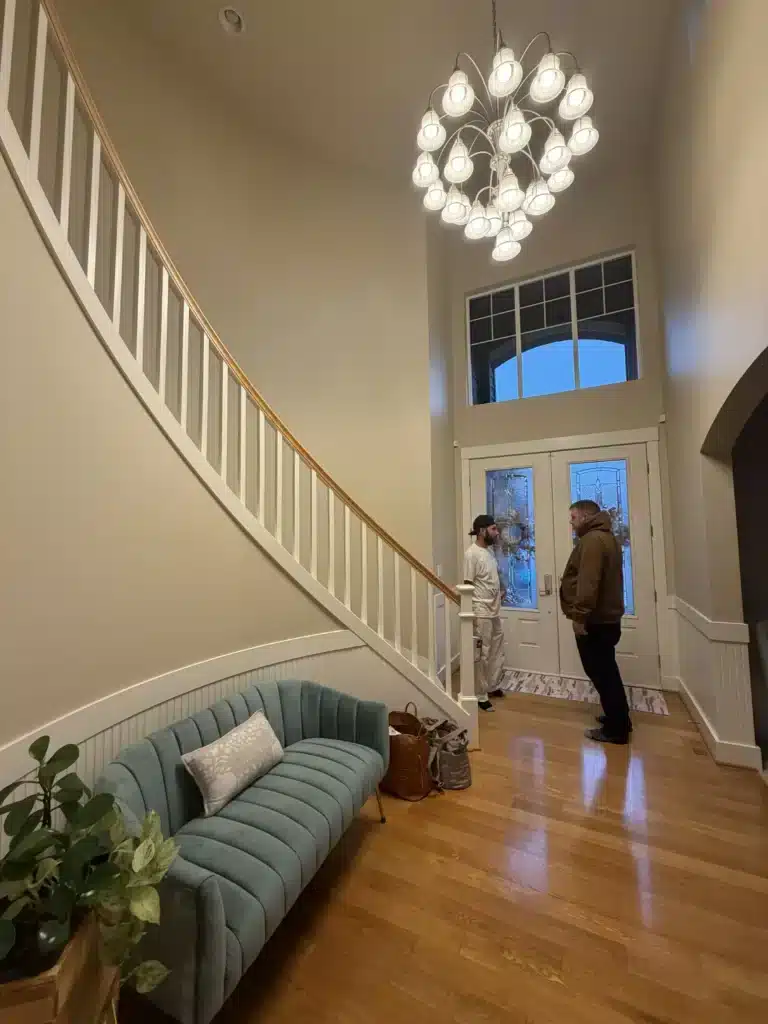
Lines Painting’s current estimating process includes an on-site walkthrough, a review of surface condition and prep needs, and a discussion of paint and material options before the written quote is prepared.
That is when ceiling repairs, wall patches, trim issues, and other prep needs should be identified so they do not interrupt the finish sequence later.
Trim Is Easier to Protect When It Comes Last
In the standard room sequence, trim is the final painted surface. That keeps wall roller spatter away from newly finished baseboards, casings, and doors.
It also lets the smaller detail work happen after the large ceiling and wall surfaces are complete.
If a painter uses another sequence for a specific room, ask how the finished trim will be protected while the wall work is completed.
A Fixed 24-Hour Wait Is Not the Rule
The original draft used a fixed waiting period between the ceiling and walls, but different coatings have different dry and recoat instructions. The exact product, temperature, humidity, surface condition, and film thickness can all affect timing.
Use the paint label or technical data for the ceiling coating instead of assuming every room needs the same wait. If tape will touch a recently painted surface, follow both the paint and tape manufacturer’s directions before masking it.
This keeps the sequence tied to the actual coating system instead of a generic schedule.
When the Ceiling Should Stay Out of the Project
If the ceiling is still clean and the scope only includes a new wall color, leave it alone. Protect the ceiling edge and focus on the walls instead of adding unnecessary work.
The same principle applies to a single accent wall or trim-only update. A partial repaint should be planned around the surfaces that need attention, not around a full-room checklist.
This makes the painting order flexible without making it random.
How Lines Painting Handles Kirkland Interiors
Lines Painting serves Kirkland and the surrounding Greater Seattle and Snohomish County area with interior painting for walls, ceilings, trim, doors, cabinets, and related surfaces.
The company was founded in 2022 and currently reports about 20 years of combined painting experience. Lines Painting is family owned and operated, licensed, bonded, and insured in Washington under contractor license LINESPL783KF.
Current company information confirms free estimates, a detailed walkthrough, color and product guidance, written itemized quotes, daily communication, complete cleanup, and workmanship warranty terms of up to five years depending on the project. For the full service, see our interior house painting services.
Frequently Asked Questions
Should I paint the ceiling or walls first?
For a full-room repaint, paint the ceiling first. The walls then cover minor ceiling overlap and create the final visible line beneath the ceiling.
Why does trim usually come after the walls?
Painting trim last keeps wall roller spatter off the final baseboard, door, and casing finish. It also leaves the detail work until the larger surfaces are complete.
How long should I wait after painting the ceiling?
Follow the dry and recoat instructions for the exact ceiling coating. A fixed wait time does not apply to every paint or room condition.
Do I need to repaint the ceiling when changing wall color?
No. If the ceiling is in good condition and outside the project scope, protect the edge and repaint only the walls.